
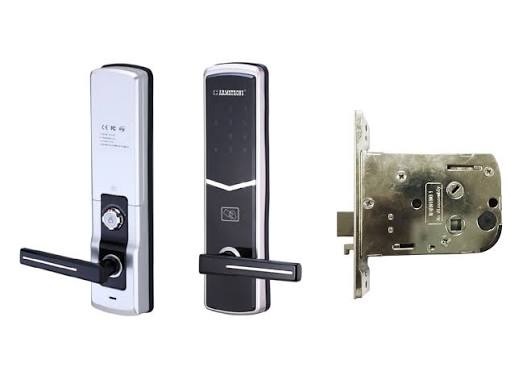
Korean & Chinese Electronic Locks in Vancouver
Anyone who has been to Korea or China knows that mechanical keys are no longer widely used in Asia. In fact, the standard in most apartment and commercial units is the keyless electronic lock. So, one of the most frequent questions we receive as professional locksmiths servicing our diverse multicultural city is why don’t we import and install Korean or Chinese Electronic Locks in Vancouver. It would be very popular!
In this article, we will discuss the difference between North American and Korean/Chinese residential locks and why they should not be installed in most apartments in Vancouver.
As always, if you have any questions or comments, please call/text me at 604-363-2760 or email me at alex@locksmithvancouver.com. Our Downtown Vancouver Key Store is generally open Monday to Friday 10am to 6pm unless I am out on a service call. We highly recommend our clients check our online calendar to make an appointment to avoid being disappointed by our absence.
Just a quick reminder that our Port Moody location is mobile-only and not open to the public.
Differences between North American and Korean/Chinese Electronic Locks
I should first preface this discussion by stating that I believe that Korean and Chinese Electronic Locks are superior to those found in Canada and the USA. There is no doubt in my mind that the quality and the level of security offered by the electronic products in those countries are far superior to those sold in our local markets.
The reason why is quite simple. The Korean and Chinese de facto standard is a keyless mortised electronic lock system. The North American de facto standard is the cylindrical keyed mechanical system.
So while I believe electronic locks in Asia are superior, I also believe our local mechanical systems are superior to those found in Asia.
It is interesting that regardless of which product you use, there is a good chance it was manufactured in Korea or China. Most of the off-brands lock hardware used by locksmiths in Vancouver come from those two countries.
For example, Dorex, Canaropa and Halsco products are manufactured in South Korea. GMS products are made in China. With current US tariffs and counter tariffs, Asian made lock hardware is quickly becoming the default choice for most Vancouver locksmiths.
Mortise vs Cylindrical Locks
One of the most noticeable differences between the locks of Asia vs North America is that most Asian locks are mortise lock body types where the whole lock mechanism is protected within a metal enclosure. North American cylindrical systems are more exposed.
Here, we consider mortise type locks to be of higher quality than the cylindrical types. In addition to better protection, they are also most expensive to design and manufacture.
In North America, Schlage pioneered the use of cylindrical locks in the early part of the 20th century, not because it was of higher quality, but because it was cheaper to make in mass production facilities with thinner metals.
Higher Security Level
The security level of locks from both regions of the world differs based on price and brand. Generally, Korean and Chinese electronic locks are paired with mortise lock bodies with a deadlatch system similar to North American Locks. However, whereas North American mortise and cylindrical locks have one deadbolt, many Asian locks have three or four deadbolts in the same lock body.
The more deadbolts a lock has, the higher the level of security. As a result of this design philosophy, the electronic locks from Korea and China tend to be significantly bigger in terms of width, length, and height. Most Asian doors are taller as well compared to those in Vancouver.
Interestingly, the door thickness is still the same. Most exterior and apartment front doors are 45mm or 1-¾” thick. Most interior doors are 35mm or 1-⅜” thick. Which are the same for doors in North America.
This will be important later in the article as to why we should not install these locks in Vancouver.
Ease of Use and Convenience
The most talked about reason why Koreans and Chinese love their country’s locks and hate the North American ones is the ease of use.
Most of them use fingerprint scanners so you don’t even need to memorize a PIN code. They usually come with a host of technologies tied to your smart phone and home system. You can easily track codes and assign visitor codes as needed.
Features that North American lock brands have implemented only in the past few years have been the default standard in Korean and China for decades.
Another reason why it is more convenient in Korea and China is that the building’s keyless and fobless system is integrated with your apartment’s front door lock.
In Vancouver, you will need to use your building FOB to gain access to the front lobby and elevator. Then you can enter in your pin code to unlock the door.
In many Asian countries, a system will scan your face to unlock the building’s front door and activate the elevator. Then you simply open your apartment front door by unlocking it with your thumbprint.
It is a much more seamless and integrated system of access control.
Why you should not install a Korean or Chinese Electronic Lock in Vancouver
So if the Korean or Chinese electronic locks are so good, why don’t we install them here in Vancouver? There is certainly enough interest from our clients and I do get a call from various consulates once or twice a year offering to help import their country’s products to Canada.
Reason #1: Metric vs Imperial
For Vancouverites or Canadians not in the construction industry, you may assume that every industry uses the Metric System of measurement. After all, we are Canadians, not Americans who use the strange Imperial System.
Unfortunately, the standard in the construction industry in Canada is the Imperial System. Everything is measured and sold in terms of inches and feet.
For example, most Asian doors are either 35 mm to 45 mm in door thickness. North American doors are 1-⅜” or 1-¾” in door thickness. Now, 35mm is very close to 1-⅜” and 45 mm is very close to 1-¾”, but they are not the same.
These little differences in door thickness, hole sizes, and backsets will add up to a lock that does not fit quite right into North American doors. Something is always a bit too tight, a bit too loose, or just slightly out of alignment.
The best way would be to start with a new slab door with no holes, then mark the location of every new hole and mortise using the metric system. In addition, all of your tools will need to be sized according to the metric system as well.
To summarize, metric based door hardware does not mesh well with imperial based doors and frames.
Reason #2: Door and Frame Materials
In Canada, the most common type of framing is called stick framing. Basically, most homes are constructed using sticks of wood. This has become the preferred way of framing in North America as wood has always been plentiful and cheaper than concrete or masonry. This has led to many other features of our homes being made of wood as well. Such as our doors and frames.
Any European or Asian will tell you that this is not the case in the rest of the world. Most of the world does not have access to vast amounts of untouched forested lands. As a result, concrete and masonry is much more common as a building material. Since wood is expensive and less common, doors and frames are made out of metal.
This has three distinct advantages. First, metal doors with fire retardants can meet higher levels of fire resistance. Metal doors can reach up to 3 hours of fire resistance before failure. Most wood doors max out at 20 minutes.
Second, metal doors are inherently more robust and secure. They can take far more damage than wood doors. Even after significant damage. Metal doors and frames can be bent back into shape or repaired like repairing a body of a car.
Third, metal doors allow for larger locks without compromising structural integrity. For example, let’s take a look at a Chinese lock that someone installed at a condo in Vancouver.
Immediately, we can see that this lock was not properly installed in the first place. Proper mortising tools were not used resulting in a rough mortise pocket. Wood holes were not pre-drilled which caused significant splits in the door.
On the frame, we can see that so much wood had to be removed from the frame that there is barely any left. Without 3” screws holding the plate to the stud next to the frame, a good hard kick would cause the frame to splinter and force the door open.
More importantly, this retrofit has caused the door and frame to lose its fire rating. For fire protection and fire insurance purposes, both the door and the frame will need to be replaced. If not, this door may endanger lives and the homeowner’s insurance company will have cause to deny any claims.
A metal door and frame would still be secure even with such a large strike plate. After all, metal is much more durable than wood. Especially if the frame has been filled with concrete or grout during construction.
Reason #3: Warranty and Customer Support
Residential Electronic Locks suffer from the same quality control issues that plague the whole consumer electronic market. There will be lemons that do not work at all, and there will be those that fail prematurely.
Korean and Chinese electronic locks without local distribution networks do not have reliable customer support or warranty programs. If they fail, you will be left with a door that you cannot open or lock. Plus, a door that no longer can use standard North American locks.
So make sure the lock you are buying is a well known brand with years of reliable reviews. If it fails, you will at least be able to take it back to your home country and try to get a refund or a replacement.
As for local service or repairs, I do not know any locksmith that will touch these locks with a 40 ft pole. We don’t see them enough to know what to do, the instruction manuals are never in English, and we can’t get spare parts anyhow. You will be completely on your own.
Conclusion
To conclude, do not import a Korean or Chinese lock to Vancouver and try to install it. I have never met a client who did that and not regretted it. Plus, you cannot do this without decertifying the fire rating of your door. Fire protection and fire insurance is not something you want to lose just for a more convenient lock.
So even if the North American locks are simpler, clunky, and ugly, I highly recommend you stick with what is locally available. The industry designs them a certain way for various legal and other reasons.
To learn more, please call or text me at 604-363-2760 or email me at alex@locksmithvancouver.com. I am always interested in finding out about new products coming onto the market, so if you know something I don’t, I would love to hear from you.

